
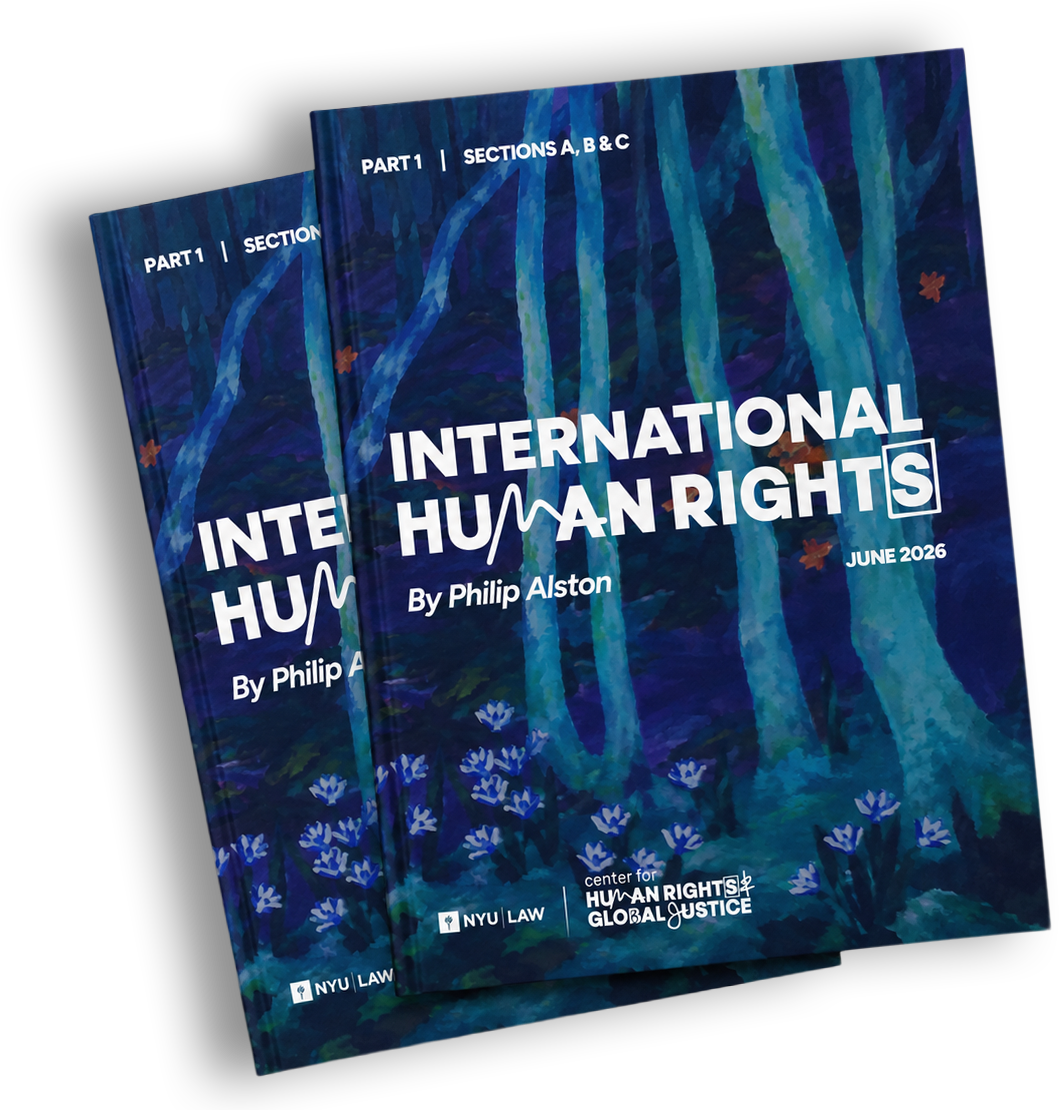
A free and open-access textbook addressing today’s human rights challenges.
Written by Philip Alston, this publication takes a critical look at international human rights law and is designed for students, educators, and global practitioners.
Grounded in law.
Shaped by today’s realities.
This book examines the world of contemporary human rights, including legal norms, political contexts and underlying ethical and moral ideals. It acknowledges the regime’s strengths and weaknesses, and focuses on today’s principal challenges. These include authoritarianism, radical inequality, resurgent racism, the rise of anti-gender ideology, artificial intelligence, the continuing marginality of economic, social and cultural rights, climate change, and the evermore central role of the private sector.
The boundaries of the subject have steadily expanded as the post-World War II regime has become an indelible part of the legal, political and moral landscape. Given the breadth and complexity of the regime, the book takes an interdisciplinary and critical approach.
This edition is a successor to previous volumes:
International Human Rights in Context (1996, 2000 and 2008, all co-authored with Henry Steiner and in 2008 also with Ryan Goodman),
International Human Rights: Text and Materials (2013, co-authored with Ryan Goodman).
A complete, critical education in international human rights law.
Explore 18 chapters across 6 sections, covering:
-

Foundational principles and legal frameworks
Explore the historical roots, philosophical foundations, and legal basis of international human rights. This section introduces key concepts, treaties, and institutions that define the field today.
-

Civil, political, social, and economic rights
Understand the full spectrum of rights protected under international law. From free speech to healthcare, this section examines how these rights are defined, debated, and enforced across contexts.
-

Universalism, relativism, and ethical dilemmas
Dive into the global debates that shape human rights discourse. Explore tensions between cultural diversity and universal norms, and the ethical challenges that arise in applying rights across borders.
-

Global and regional enforcement mechanisms
Learn how human rights are upheld—or challenged—through global and regional institutions. This section covers the UN system, regional courts, treaty bodies, and other tools of accountability.
-

States, non-state actors, and accountability
Examine the complex web of responsibility in the human rights landscape. From governments to corporations and NGOs, this section explores how actors are held accountable for rights violations.
-

Current crises—from armed conflict to climate justice
Analyze how international human rights respond to today's most pressing challenges. Topics include war, displacement, racial injustice, climate change, and the global backlash against gender and democracy.
Notable reviews.
Teaching human rights today.
A new online open-access human rights textbook is an opportunity to model true accessibility and to incorporate updated approaches in this complex field.

About the author, Philip Alston.
Professor of Law, New York University School of Law
Faculty co-Director, Center for Human Rights & Global Justice at NYU Law
At NYU, Philip teaches international law, human rights law, the political economy of human rights, and strategic human rights litigation. He brings both a scholarly and practical perspective. From 2014 to 2020, he was UN Human Rights Council special rapporteur on extreme poverty and human rights. He has also been UN special rapporteur on extrajudicial executions (2004-2010), Chairperson, UN Committee on Economic, Social and Cultural Rights (1991-98), and a member of the Commissions of Inquiry established by the UN Security Council, the UN Human Rights Council and the OSCE.